Write what the video should say. Endroll cuts it from your footage.
For people who shoot but don't edit. Endroll's AI finds the moments in your own clips and builds an editable cut, in the order you wrote. It invents nothing, and your video files are never uploaded.
The gate was never talent. It was three hours of watching.
A proper cut has meant hiring an editor or spending years learning to be one. Endroll watches the hours for you and hands you the cut.
Write what it should say. Watch it become a cut.
The app as it ships, recorded: the script on the right, the cut it became on the timeline. No timeline skills were used.
You already shot it. It's sitting on a drive.
Webinars, trade fairs, interviews, training days. The footage exists. What's missing is three hours to watch it and the years it takes to learn an editor. So it waits, or you pay someone and wait a week.
Endroll does the watching and the first cut. You keep the story and the final say. Professional editor? It does the assistant editor's work and hands you a clean timeline for your own bay.
Three moves. No timeline skills.
This is the whole workflow. Each step below is recorded in the app as it ships.
Pick the folder: phone clips, camera cards, last week's interview. Endroll reads what is in every shot and what is said in it.
You never scrub through footage again.Write what the video should say, a brief or a full script. No script yet? Endroll drafts one from what you actually shot.
The story stays yours, in your words.Get back a cut with whole sentences, pauses respected, captions and your music under the dialogue. Approve it, or say what to change.
An editable cut, not a locked export.Forty-five seconds, start to cut.
A folder of footage, a script, and the cut that came back. Nothing in it was staged for the camera: this is the app, recorded.
How it works, step by step →
It doesn't make video. It cuts yours.
Six kinds of tools promise video with AI. Here is what each one gives you, and what you get instead. The closest to Endroll's job are the agentic editors; the difference is where your files go and what gets mixed in.
A finished video from a document or a prompt: avatars, stock, generated clips. No camera needed, and nothing in it happened at your event.
The cut is made from the files you shot. Generation is a tool inside it, for a missing shot, a graphic, music or a voice, used only when you ask and priced first.
Upload your footage, describe the edit, get a base cut on a timeline. Stock and generated clips sit in the project beside yours, and the files live in the vendor's cloud.
The same job on your computer. Your video files are indexed here and never uploaded, nothing is generated by default, and each AI job shows its price before it runs.
Logging, transcription and a rough cut handed to Premiere, Resolve or Final Cut. Built for editors; proxies or footage go to the cloud; credits by the hour of footage imported.
The cut itself, for the person who wrote the brief, rendered on your computer. Hours of footage cost no credits. The export to Premiere, Resolve or Final Cut is there when an editor takes over.
One long video becomes many short vertical clips, picked by an algorithm for hooks, captioned and posted.
Many clips become one considered film, in the order you wrote.
Record, then edit one recording by editing its text. Building a piece from many clips is still your job, and the media is in the cloud.
Start from a folder of clips from several cameras and a script. The AI assembles, you approve.
All the power, if you have the skill and the hours. AI search and text-based trims inside, the assembly still yours.
No timeline skill needed. Graphics, sound and generation are inside, no plug-ins. When an editor takes over, export the cut to Premiere Pro, Resolve or Final Cut.
Facts about other tools come from their own pages and are dated. The detailed comparisons, with sources →
A real cut, not a sizzle reel.
The editor as it ships, with a documentary cut from an astronaut interview and the footage around it. Every shot is a row carrying the line spoken in it. Approve it, or change it.
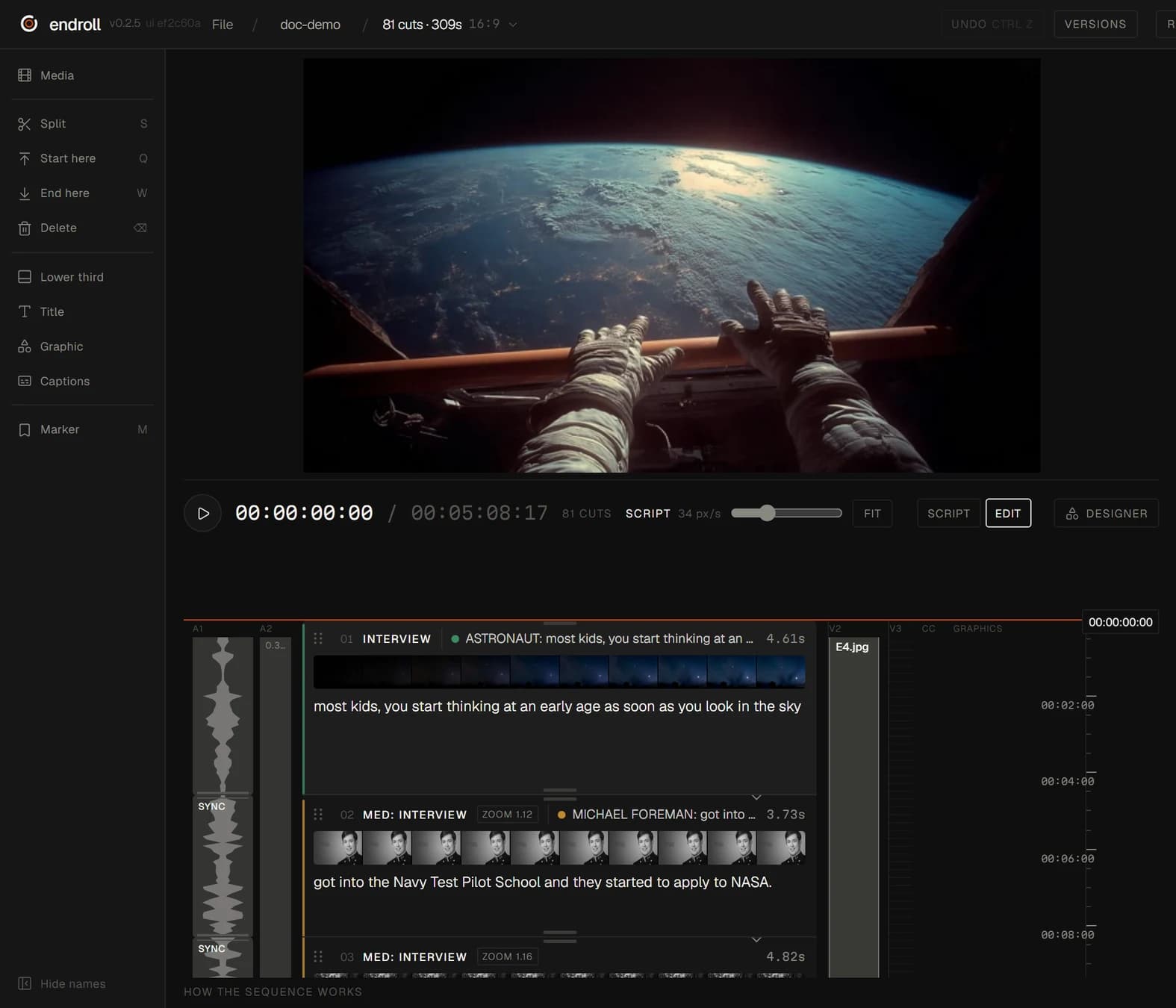
- Cuts begin and end where the speaker does. Sound may run across a cut, never over someone else's words.
- Lines your footage doesn't cover are shown as a list, not covered up with the wrong shot.
- Every draft is checked shot by shot against a professional editor's cut of the same footage.

Tell it what to change. Like you'd tell an editor.
Mechanical changes happen on the spot for a few credits. Creative work is a re-cut, and its price shows before anything runs.
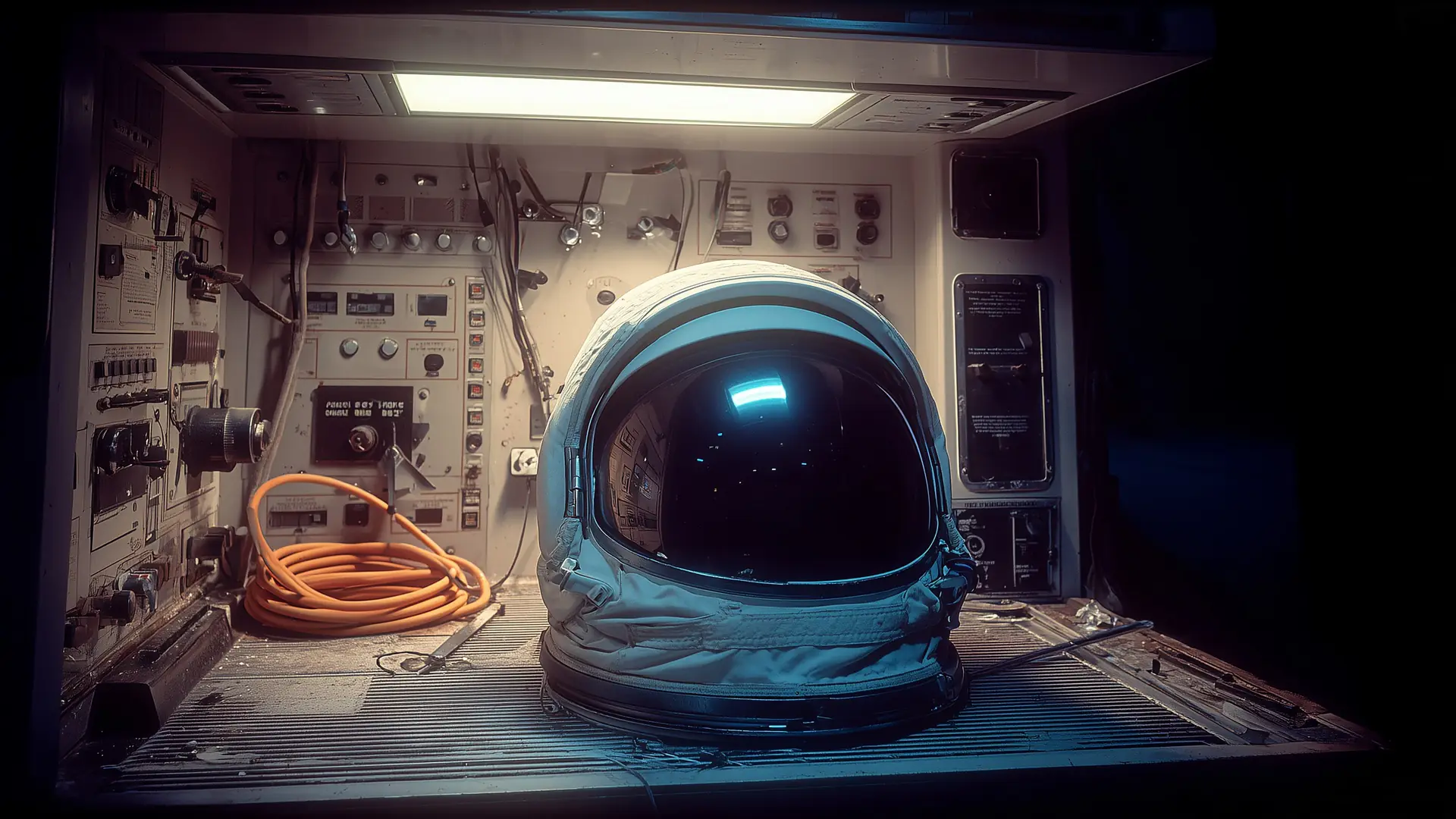
The shot you missed. The music you don't have. The graphic nobody designed.
A cut is rarely footage alone. Endroll makes the rest where the cut is, so nothing goes out to another tool and comes back as a file: a shot for a gap, music to length, a voice-over, a graphic that moves. Each one shows its price before it runs.
Describe it, or let Endroll write the prompt from the shots around the gap and your script. Pick a model, match the style of your footage, see the price per second on the button. The shot lands in the cut after the one under the line.
You pay only when it succeeds.Your own tracks come first, placed under the dialogue. For what is missing: music from a description to the length you need, a sound effect, a voice-over read from your text. Filed in your library, so the next draft can use it.
Four sound lanes, your sound first.Lower thirds and titles from templates. Anything else, describe it, including how it moves and reacts: a scoreboard that counts up when the score changes. Pick one of three directions, then refine it in the designer: layers, keyframes, easing, masks.
No designer on call. No After Effects.Nothing is generated unless you ask: the cut itself is made only from what you shot. Graphics, sound and generation in the manual →
Hours of footage cost you nothing.
Credits buy the AI's work and nothing else. You see the price before you press the button, and you never pay by the hour of footage.
Pay for the AI's work. Not for the hours of footage.
One monthly price: the editor and the month's credits. Editing on your machine never spends a credit — credits buy the AI's work only, and every cut shows its price before you press the button. Bring one hour of footage or ten: the same cut costs the same.
Starter
For weekly publishing.
1,500 credits / month
- →The full editor — indexing, transcription, timeline, rendering
- →Export to Resolve, Premiere or Final Cut — plus subtitles
- →~6 full AI drafts a month, plus generation and re-rolls
Pro
For teams that publish every week.
5,000 credits / month
- →Everything in Starter
- →~20 full AI drafts a month — daily assisted cutting
- →Priority support
Enterprise
For teams that buy on an invoice, not a card.
- →Credits sized to your volume
- →Billing by agreement
- →A named contact
- →Security review and DPA
Top up on your plan: 1,000 credits €19 or 5,000 credits €79, paid once. Extra credits never expire, and they raise your monthly generation limit by what you buy. For subscribers only.
Sign in, download, install. Your trial opens the moment Endroll first runs on your computer: the whole editor for 14 days and 600 credits — enough for a first cut and a revision from your own footage. It ends on its own; nothing is charged unless you subscribe. If trials are full that day, the app shows you're in line. A paid plan starts right away.
Subscribe with the email you sign in with — one email, one code, no password. A cancelled plan keeps working until the end of the month you paid for. Prices include VAT where applicable — tax is handled at checkout by Dodo Payments, our Merchant of Record.

Your video files are never uploaded.
Endroll searches, cuts and renders on your computer. The cloud hears the speech audio for the transcript and sees small preview frames of each shot, never the video. Private mode keeps even those at home. Built for client work, internal material and anything your IT department would never let you upload.
Private mode is one switch. With it on, transcription and shot descriptions run on your own machine.
Neither is your edit locked in. Export the timeline to DaVinci Resolve, Premiere Pro or Final Cut whenever you want.
Built by an editor, for the people who used to hire one.
“I've cut video professionally for over 20 years, and somewhere along the way I noticed where my attention was actually going. Not into the story. Into the software.”
Let me be straight: AI does not yet cut a finished video that clears a professional bar. Twenty years in, I'm as skeptical as you are. What it does cut is the first version, the one that used to take an assistant a day and you a week of waiting. That is Endroll: the simplest editor I could build, with AI doing the watching and the first cut, and the timeline yours to finish anywhere.
Tomi Paijo, founder. About Endroll →
Before you ask.
Does the AI make things up?
No. The cut is made from what you shot: it finds the moments and puts them in the order you wrote. A line with no footage is listed as missing. Generated music or graphics appear only when you ask for them.
Do I need to know how to edit?
No. You write what the video should say and approve the cut. If you do edit, the full editor is there, and the timeline exports to Premiere Pro, DaVinci Resolve or Final Cut.
How is this different from Synthesia, HeyGen and other AI video generators?
They make a video from a document or a prompt with avatars, stock or generated clips. Endroll's cut is made from the video you shot; generation is a tool inside it, for a missing shot, a graphic or music, used when you ask. If the video is about your event, your team or your customer, the footage has to be yours.
And from InVideo or Cardboard?
Those are agentic editors in the browser: you upload the footage, describe the edit and get a base cut, with stock and generated clips available in the same project. Endroll does that job on your computer. Your video files are never uploaded, nothing is generated unless you ask, and every AI job shows its price before it runs.
How far do the credits go?
A full AI draft of a five-minute film is about 225 credits, so Starter covers about 6 a month and Pro about 20. Small changes in chat cost a few credits and need no re-cut. Every paid job shows its price first, and editing by hand never spends a credit.
What leaves my computer?
Your video files are never uploaded. Search, editing and rendering run on your computer. Speech is transcribed in the cloud from the audio track and shot descriptions use small preview frames; Private mode keeps both on your computer.
What does it run on?
Windows 10/11 (64-bit), or a Mac with Apple silicon (M1 or newer, macOS 13+). The trial opens the moment the installed app first runs: 14 days, 600 credits, no card.